
Understanding the fundamental distinction between passive voice vs active voice is crucial for any writer aiming for precision, impact, and overall effectiveness. The choice between these two grammatical constructions profoundly influences how a message is received, affecting clarity, conciseness, and even the perceived authority of the text. While active voice is often championed for its directness, the passive voice holds legitimate, strategic applications. This article will dissect both voices, providing a comprehensive guide to their definitions, uses, and the strategic considerations that inform their deployment in professional writing.
Defining Active Voice: The Direct Approach
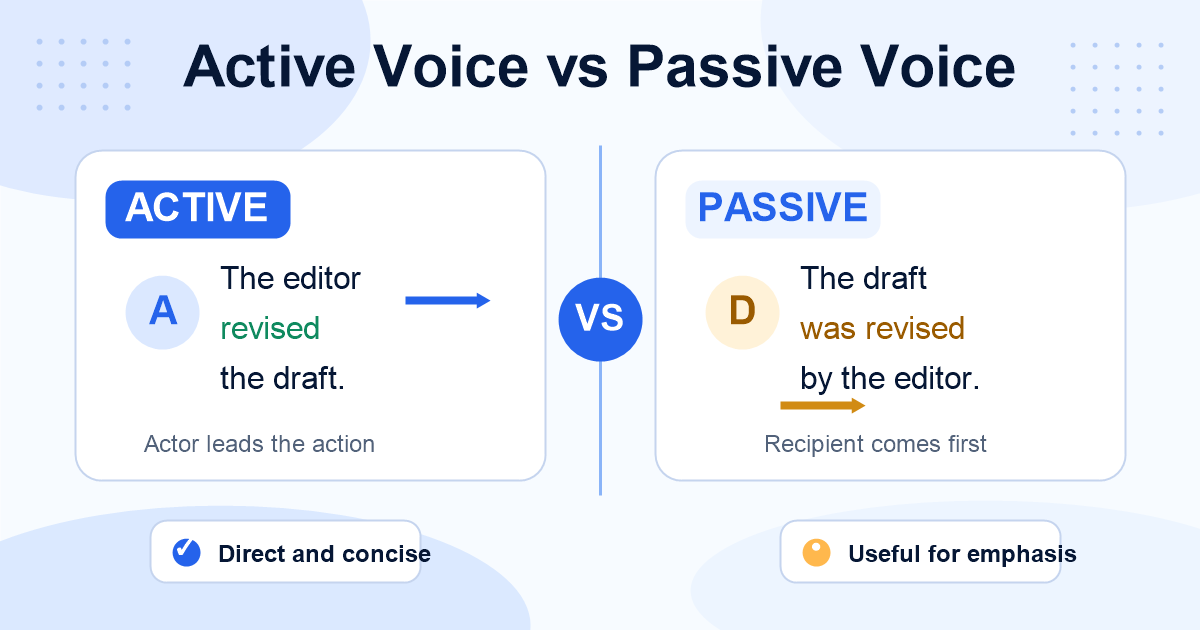
Active voice is characterized by its directness, making it a powerful tool for clear and impactful communication. It places the actor of the sentence at the forefront, clearly indicating who or what is performing the action. This structure naturally leads to more concise and engaging prose, which is often why active voice is preferred in most forms of communication.
What is Active Voice?
- The active voice definition centers on a straightforward grammatical structure: Subject + Verb + Object. In this construction, the subject of the sentence performs the action expressed by the verb. The object then receives that action. This direct relationship between the subject and the action creates a sense of immediacy and responsibility, making the sentence easy to understand.
For instance, in the sentence "The engineer designed the bridge," "The engineer" is the subject performing the action "designed," and "the bridge" is the object receiving the action. The actor is clear, and the sentence is unambiguous.
Active Voice Examples in Practice
To illustrate the directness and impact of this construction, consider these active voice examples:
- Business Communication: "Our team launched the new product last quarter." (Clear accountability)
- Technical Writing: "The software processes data efficiently." (Focus on the software's capability)
- Journalism: "The committee approved the budget proposal." (Identifies the decision-makers)
- Creative Writing: "The detective solved the complex case." (Emphasizes the detective's agency)
- Everyday Speech: "She wrote the report." (Simple, direct statement)
Each example clearly identifies the agent performing the action, contributing to a strong, unambiguous message.
Why Active Voice is Preferred in Writing
Editors, style guides, and communication experts consistently advocate for active voice for several compelling reasons. Primarily, it enhances clarity by explicitly stating who is doing what. This directness reduces ambiguity and prevents misinterpretation. Sentences written in active voice are also typically more concise, using fewer words to convey the same information, which improves readability and flow; the Word Counter can help check length and reading time during revision.
Furthermore, active voice injects energy and dynamism into writing. It makes prose more engaging and authoritative, as the actor takes responsibility for the action. This is particularly important in persuasive writing, technical instructions, and professional reports where clarity and accountability are paramount. The consistent use of active voice in writing helps to create a strong, confident tone that resonates with readers.
Defining Passive Voice: The Indirect Approach
While often advised against, passive voice is not inherently incorrect. It serves a distinct purpose by shifting the emphasis within a sentence, focusing on the action or the recipient of the action rather than the performer. Understanding its structure and implications is key to knowing when and how to use it effectively.
What is Passive Voice?
The passive voice definition describes a grammatical construction where the subject of the sentence is the recipient of the action, not the performer. The typical structure involves a form of the verb "to be" (e.g., is, was, has been) followed by the past participle of the main verb. The agent performing the action is often omitted or introduced by the preposition "by." The structure is generally Object + Form of "to be" + Past Participle (+ by Agent).
For example, "The bridge was designed by the engineer." Here, "The bridge" is the subject receiving the action, "was designed" is the passive verb, and "by the engineer" identifies the (optional) agent. The focus shifts from the engineer to the bridge.
Passive Voice Examples for Clarity
- Observing various passive voice examples helps to grasp its construction and the subtle shift in emphasis:
- Business Communication: "The new product was launched last quarter." (Focus on the product launch, not who launched it)
- Technical Writing: "Data is processed efficiently by the software." (Emphasis on the data processing)
- Journalism: "The budget proposal was approved." (Focus on the approval, not necessarily who approved it)
- Creative Writing: "The complex case was solved by the detective." (Emphasis on the case being solved)
- Everyday Speech: "The report was written by her." (Focus on the report)
These examples demonstrate how the passive voice can be used to highlight the action or its recipient, often de-emphasizing the actor.
How to Identify Passive Voice in Your Text
Learning to identify passive voice is a critical skill for refining your writing, especially before using a Case Converter to clean up final formatting. The most reliable indicator is the presence of a form of the verb "to be" (is, am, are, was, were, be, being, been) immediately followed by a past participle (a verb ending in -ed, -en, -t, etc., like "written," "broken," "built"). If you can insert "by [someone/something]" after the verb phrase, even if it's not explicitly stated, it's likely passive.
- Consider these patterns:
- "The decision was made." (Can be "was made by someone")
- "The report has been completed." (Can be "has been completed by someone")
- "Errors are often overlooked." (Can be "are often overlooked by people")
While not every "to be" verb indicates passive voice (e.g., "She is happy" is active), the combination with a past participle is the key to recognizing this construction.
Passive Voice vs Active Voice: A Comparative Analysis
The distinction between passive voice vs active voice extends beyond mere grammatical structure; it fundamentally alters the emphasis, clarity, and overall impact of your communication. Understanding these differences is paramount for making informed stylistic choices. For another sentence-level formatting comparison, see title case vs sentence case.
Clarity and Conciseness
Active voice generally excels in clarity and conciseness. By directly stating the actor, the action, and the recipient, it creates a clear, unambiguous path for the reader to follow. Sentences like "The committee approved the proposal" are direct and efficient. Passive constructions, such as "The proposal was approved by the committee," often add extra words ("was approved by" instead of "approved") and can obscure the agent, potentially leading to vagueness if the "by" phrase is omitted ("The proposal was approved"). This wordiness can slow down reading and dilute the message.
Emphasis and Focus
This is where the strategic choice between the two voices becomes most apparent. Active voice places emphasis on the actor. "The CEO announced the merger" highlights the CEO's role. Passive voice, conversely, shifts the emphasis to the action or the recipient of the action. "The merger was announced by the CEO" focuses on the merger itself, with the CEO's role being secondary. If the merger is the primary topic of discussion, the passive construction might be more appropriate. If the CEO's authority or action is the main point, active voice serves better.
Readability and Engagement
Active voice typically leads to more readable and engaging prose. Its directness creates a more dynamic and energetic tone, drawing the reader into the narrative. Sentences feel stronger and more immediate. Passive voice, while not inherently bad, can sometimes make writing feel more formal, detached, or even evasive. Overuse of passive voice can result in a monotonous, bureaucratic, or overly academic tone that disengages the reader. For most general communication, especially where you want to connect with your audience, active voice is the preferred choice for maintaining reader interest.
Strategic Use: When to Use Passive Voice
Despite the general preference for active voice, there are specific, legitimate scenarios when to use passive voice. These instances are not about avoiding active voice but about making a deliberate choice to achieve a particular rhetorical effect or to suit the context.
When the Actor is Unknown or Unimportant
One of the most common and valid reasons to use passive voice is when the agent performing the action is either unknown, irrelevant, or obvious from the context. In such cases, focusing on the action or its recipient makes more sense.
- "The window was broken last night." (The person who broke it is unknown.)
- "Mistakes were made." (The speaker wishes to avoid identifying the specific individuals responsible.)
- "The building was constructed in 1920." (The specific builders are unimportant; the building's age is the focus.)
To Maintain Objectivity or Formality
Passive voice can lend a sense of objectivity and formality to writing, which is often desirable in certain professional contexts. By de-emphasizing the actor, the focus shifts to the process or the outcome, making the statement seem less personal or biased.
- "The decision was reached after careful deliberation." (Sounds more formal and objective than "We reached the decision...")
- "All employees are required to complete the training." (Emphasizes the requirement, not who requires it.)
For Scientific or Technical Reporting
In scientific papers, lab reports, and technical documentation, the process, methodology, or results are often more important than the individual who performed the experiment or analysis. Passive voice is frequently used to maintain this focus and to present findings in an impersonal, objective manner.
- "The samples were heated to 100 degrees Celsius." (Focus on the experimental procedure.)
- "Data was collected over a period of three months." (Emphasis on the data collection process.)
- "The hypothesis was disproven by the experimental results." (Focus on the outcome.)
To Vary Sentence Structure and Flow
While overuse of passive voice can lead to monotony, occasional, strategic use can help vary sentence structure and improve the overall flow of a paragraph. A string of active sentences can sometimes feel repetitive. Introducing a passive construction can break this pattern, providing a rhythmic change without sacrificing clarity, especially when the context naturally supports it.
- "The team completed the first phase. The second phase was initiated shortly after. They then prepared for the final review." (Breaks up the rhythm of active sentences.)
Transforming Sentences: How to Convert Passive to Active Voice
Knowing how to convert passive to active voice is a valuable skill for any writer seeking to enhance clarity, conciseness, and impact. This process involves identifying the key components of a passive sentence and rearranging them into the active structure.
Identifying the Agent and Action
The first step in converting a passive sentence to active is to identify the agent (the performer of the action) and the action itself. In a passive sentence, the agent is often found in a "by" phrase, or it might be implied.
- Passive: "The report was written by the intern."
- Agent: "the intern"
- Action: "written"
Recipient/Object: "The report"
If the agent is missing (e.g., "The report was written"), you'll need to infer or invent a logical agent (e.g., "someone," "the team," "I").
Practical Steps for Conversion
Once you've identified the agent and action, follow these steps:
- Find the Agent: Locate the performer of the action. If it's in a "by" phrase, that's your new subject. If it's missing, decide who or what performed the action.
- Make the Agent the Subject: Move the agent to the beginning of the sentence to become the new subject.
- Identify the Main Verb: Take the past participle from the passive construction (e.g., "written," "designed") and convert it into its active form.
- Place the Object After the Verb: The original subject of the passive sentence (the recipient of the action) becomes the object of the active sentence, placed after the active verb.
- Remove "to be" and "by" phrases: Eliminate the auxiliary "to be" verb and the "by" phrase.
Conversion Examples: Before and After
- Here are several examples demonstrating how to convert passive to active voice:
Passive to Active Conversions
| Passive Voice | Active Voice |
|---|---|
| The ball was thrown by the boy. | The boy threw the ball. |
| The decision was made by the committee. | The committee made the decision. |
| The new policy will be implemented by the department. | The department will implement the new policy. |
| Mistakes were made. (Implied agent: someone) | Someone made mistakes. |
| The report has been reviewed by the manager. | The manager has reviewed the report. |
Practicing these conversions will sharpen your ability to identify and transform passive constructions, leading to more dynamic and direct writing.
Mastering Voice in Your Writing
Achieving mastery over grammatical voice means more than simply avoiding passive constructions. It involves developing a nuanced understanding of when each voice serves your purpose best, ultimately leading to more effective and persuasive active voice in writing.
Developing an Awareness of Voice
The first step toward mastering voice is cultivating a conscious awareness of your choices during both the drafting and revision stages. As you write, consider who or what is performing the action in each sentence. If the actor is clear and important, lean towards active voice. If the action or its recipient is the primary focus, or if the actor is unknown, passive voice might be appropriate.
During revision, actively scan your sentences for passive constructions. Ask yourself: "Is the actor clear? Is this the most direct way to convey this information? Does this sentence feel energetic or sluggish?" This deliberate reflection will help you make informed decisions rather than defaulting to one voice over the other; the text case formatting guide can help with surface formatting after the sentence structure is clear.
Tools and Techniques for Review
- Several methods and tools can assist you in identifying and refining your voice usage:
- Reading Aloud: Reading your text aloud can often highlight awkward or wordy passive constructions that might go unnoticed when reading silently. Sentences that sound clunky or overly formal are often candidates for conversion to active voice.
- Grammar Checkers: Many word processors and online grammar tools (e.g., Grammarly, ProWritingAid) can identify passive voice. While these tools are helpful, remember to use them as suggestions, not strict rules. Always apply your judgment based on context and intent.
- Focus on "to be" verbs + Past Participle: Systematically search your document for forms of "to be" (is, am, are, was, were, be, being, been) followed by a past participle. This is the most reliable way to spot passive constructions.
The "by zombies" Test: A humorous but effective trick is to try adding "by zombies" after the verb. If the sentence still makes grammatical sense (even if nonsensical), it's likely passive. For example, "The report was written (by zombies)."
Conclusion
The debate over passive voice vs active voice is not about declaring one inherently superior to the other, but rather about understanding their distinct functions and deploying them strategically. Active voice, with its directness and clarity, remains the default for most impactful communication, fostering conciseness, energy, and accountability. However, passive voice holds a valuable place in specific contexts, such as when the actor is unknown, objectivity is paramount, or in certain scientific and technical reports.
Ultimately, effective writing stems from an informed choice. By mastering the ability to identify, understand, and strategically employ both active and passive constructions, writers can craft prose that is not only grammatically sound but also clear, engaging, and precisely tailored to its purpose and audience. This nuanced approach leads to stronger, more impactful communication that resonates with readers.