
Proper capitalization is fundamental to clear, professional writing. It guides the reader, signals importance, and keeps your content polished. Misplaced capitalization can make even useful text feel rushed or harder to read.
This guide clarifies title case vs sentence case, including the rules for each style, when to use them, and how to apply proper headline capitalization with practical examples. For broader formatting context, start with the text case formatting guide, then use a case converter when you need to convert text case quickly.
Title Case vs Sentence Case: The Core Difference
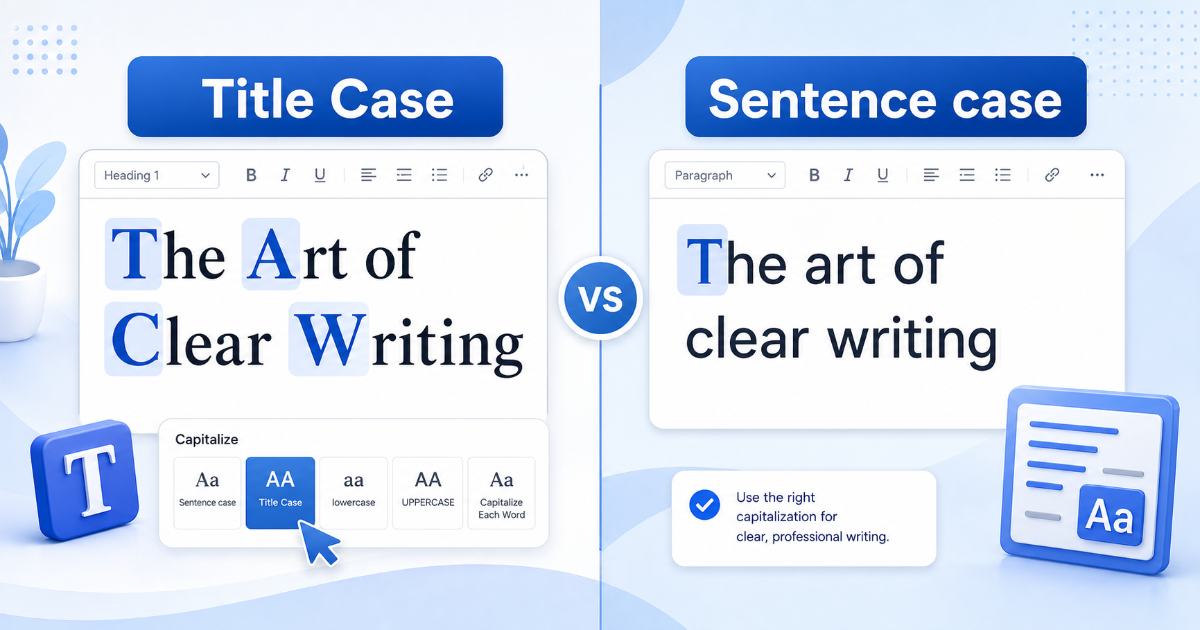
The difference between title case and sentence case comes down to how many words are capitalized and why. Title case gives emphasis to major words, so it feels formal and title-like. Sentence case follows normal sentence capitalization, so it feels readable, direct, and natural.
Direct Comparison
| Style | Pattern | Example |
|---|---|---|
| Title Case | Capitalize major words and the first and last words. | The Art of Writing Clear and Concise Documentation |
| Sentence case | Capitalize only the first word, proper nouns, and acronyms. | The art of writing clear and concise documentation |
Understanding Title Case
Title case is primarily used for formal headings, titles of works, and important named sections. It gives prominence to significant words, helping the title stand apart from surrounding body text.
The core title case rules
Most title case systems capitalize the first and last words of a title, plus major words such as nouns, pronouns, verbs, adjectives, adverbs, and subordinating conjunctions.
- Nouns
- Pronouns
- Verbs, including is, are, and be
- Adjectives
- Adverbs
- Subordinating conjunctions such as because, if, than, and while
Minor words are usually lowercase unless they are the first or last word. These include articles, coordinating conjunctions, and short prepositions. For a deeper guide to style-guide differences, read our article on title capitalization rules.
- Articles: a, an, the
- Coordinating conjunctions: and, but, for, or, nor, so, yet
- Short prepositions: in, on, at, to, by, for, of
Title case examples
- The Importance of Being Earnest
- How to Write an Effective Business Proposal
- Gone With the Wind
- A Tale of Two Cities
- Searching for the Meaning of Life
- The Art of War
- What Is It All About?
Understanding Sentence Case
Sentence case mirrors standard sentence capitalization. It prioritizes readability and is the default for most writing because it is simple, consistent, and easy to scan.
The straightforward sentence case rules
- Capitalize the first word of a sentence or heading.
- Capitalize proper nouns, such as people, places, organizations, and specific brands.
- Capitalize acronyms and initialisms, such as NASA, CEO, SEO, and API.
- Keep all other words lowercase.
Sentence case examples
- The quick brown fox jumps over the lazy dog.
- Microsoft released a new operating system.
- The CEO announced the company's quarterly earnings.
- Click here to learn more about our services.
- This report details the project's progress.
When to Use Title Case
Use title case when formality, prominence, or a distinct title treatment is important. Proper headline capitalization helps separate these elements from normal prose.
Formal titles and headings
Use title case for book titles, article titles, chapter headings, major report sections, movie titles, songs, albums, and presentation headings.
Publication names and proper nouns
Use title-style capitalization for names of magazines, newspapers, specific laws, historical events, awards, and other formal proper nouns when that style is part of the name.
When to Use Sentence Case
Use sentence case when readability and natural flow matter more than formal emphasis. It is especially helpful on websites, in apps, and anywhere readers need to scan quickly.
Body text and general paragraphs
Sentence case is standard for article body text, reports, emails, books, paragraphs, informal headings, and explanatory copy.
Descriptions, labels, and UI elements
Use sentence case for product descriptions, button labels, menu items, field labels, captions, footnotes, and many news headlines.
Consistency and Style Guides
Whether you choose title case or sentence case, consistency matters. Inconsistent capitalization distracts readers and can reduce trust. Style guides give you a shared standard for writers, editors, designers, and content teams.
- Chicago Manual of Style: Often used in book publishing and academic writing, with detailed title case rules.
- Associated Press style: Common in journalism and public relations, often preferring sentence case for headlines.
- MLA Handbook: Common in humanities writing, with specific rules for titles of works.
Academic writers should compare APA title capitalization with MLA title capitalization because the same source title may be formatted differently in a reference list or Works Cited entry.
Tools can help, but they work best when paired with editorial judgment. A case converter can transform headings quickly, while a word counter can help review title length, character count, and article structure before publishing.
Best Practices for Clear Capitalization
Editing tip
Pick one capitalization style for each content type. For example, use title case for article titles and sentence case for section headings, then document that choice.
- Use title case for formal page titles and publication titles.
- Use sentence case for readable headings, descriptions, buttons, captions, and body text.
- Follow the required style guide for academic, journalistic, or publishing work.
- Check proper nouns, acronyms, and brand names manually after conversion.
- Avoid mixing title case and sentence case randomly on the same page.
- Keep a simple capitalization note in your team style guide.
Related Tools and Guides
Capitalization works best as part of a broader editing workflow. These resources help you format, compare, and review text before publishing.
Case Converter
Convert text case between title case, sentence case, uppercase, lowercase, and more.
Text Case Formatting Guide
Compare uppercase, lowercase, sentence case, title case, and other formatting styles.
Title Capitalization Rules
Learn how APA, MLA, Chicago, and AP handle title capitalization.
Word Counter
Review word count, character count, reading time, and editing metrics.
Choosing the Right Case for Your Content
Mastering title case vs sentence case is a practical skill for every writer. Title case adds formality and emphasis to titles and headings, while sentence case supports readability and natural flow for everyday content.
By understanding the rules, choosing a consistent style, and reviewing exceptions before publishing, you can make your writing clearer, more professional, and easier for readers to scan.