
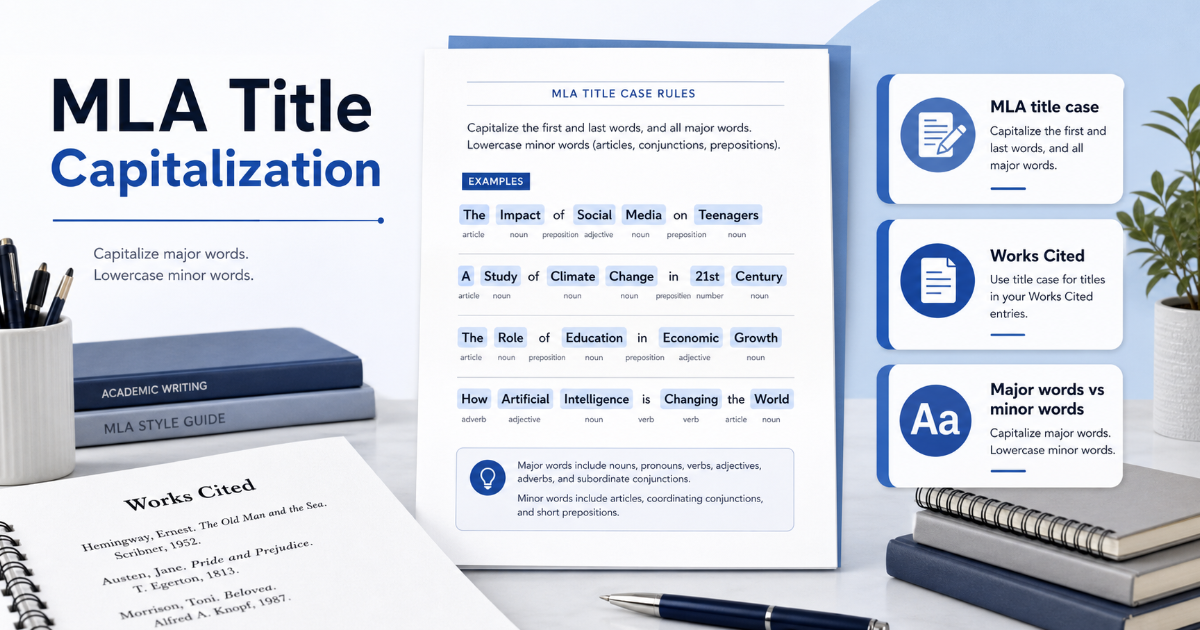
Accurate presentation of academic work is fundamental to scholarly communication. MLA title capitalization is one of the details that helps papers, headings, and Works Cited entries look polished, consistent, and aligned with academic expectations.
This guide explains the core MLA capitalization rules, the short-word exceptions, how hyphenated compounds work, and how to apply MLA title case across paper titles and source titles. For broader context, compare this with APA title capitalization, capitalization rules for titles, and title case vs sentence case.
Understanding MLA Title Capitalization Rules
The foundation of MLA title capitalization is title case. In title case, most meaningful words are capitalized, while many small function words remain lowercase unless they appear in a special position.
The foundation of MLA title case
MLA title case capitalizes all major words in titles of books, articles, essays, webpages, films, and other works. Major words include nouns, verbs, adjectives, adverbs, pronouns, and subordinating conjunctions such as because, although, if, while, and unless.
- Nouns: Book, Theory, Analysis
- Verbs: Is, Are, Be, Write, Understand
- Adjectives: Important, Critical, New
- Adverbs: Quickly, Always, Carefully
- Pronouns: He, She, It, Their
Always capitalize first and last words
The first and last words of any title or subtitle are always capitalized in MLA style, even when the word is normally considered minor.
- A Farewell to Arms capitalizes A because it is first.
- The World Is Not Enough capitalizes Enough because it is last.
- Learning How to Be capitalizes Be because it is last.
MLA Capitalization Exceptions for Short Words
MLA capitalization exceptions usually involve articles, short prepositions, and coordinating conjunctions. These words are lowercase in the middle of a title unless they are first or last.
MLA Major Words vs. Minor Words
| Word type | MLA treatment | Example |
|---|---|---|
| Major words | Capitalize | The Importance of Being Earnest |
| Articles | Lowercase unless first or last | A Study of the Human Condition |
| Short prepositions | Lowercase unless first or last | Waiting for Godot |
| Coordinating conjunctions | Lowercase unless first or last | Between the World and Me |
Hyphenated words and compound terms
For hyphenated compounds, capitalize both parts if both are major words or if the second part is a noun or proper adjective. If the second part is a minor word, keep it lowercase unless it is first or last.
- Twenty-First Century Literature
- Well-Being in the Modern Age
- A Self-Help Guide
- The Up-to-Date Handbook
Capitalization after colons and semicolons
When a title includes a colon or semicolon, capitalize the first word that follows it because it begins a subtitle or a distinct title segment.
Examples: The Digital Divide: An Examination of Access and Equity; Literary Theory: A Very Short Introduction
Applying MLA Title Capitalization in Academic Writing
MLA paper title capitalization
Your essay, research paper, or thesis title should follow MLA title case: capitalize major words, capitalize first and last words, and lowercase minor words in the middle.
Example: The Role of Social Media in Shaping Political Discourse
MLA Works Cited title capitalization
Titles in the Works Cited page also use MLA title capitalization. Apply title case to books, articles, chapters, webpages, films, and other source titles.
- Book: The Great Gatsby
- Journal article: Rethinking the Canon: Race, Gender, and the Politics of Literary Value
- Website article: How to Write a Research Paper: A Step-by-Step Guide
MLA heading capitalization
Internal headings and subheadings in an MLA paper typically use title case, which helps the paper feel organized and consistent.
- Literary Analysis of Frankenstein
- The Monster's Perspective on Humanity
- Isolation and the Search for Belonging
MLA vs. APA, Chicago, and Other Style Guides
MLA title capitalization is easy to confuse with other style guides. APA uses sentence case for many reference list titles, while Chicago uses title case with its own detailed rules for prepositions and compounds.
If you are switching between assignment styles, use a case converter to convert text case quickly, then review the output against the exact style guide. Our title capitalization rules guide compares major style guides, while the text case formatting guide explains common casing formats.
MLA Title Capitalization Examples
Book and journal titles
- The Catcher in the Rye
- Sapiens: A Brief History of Humankind
- PMLA: Publications of the Modern Language Association of America
Article and chapter titles
- The Ethics of Artificial Intelligence: A Philosophical Inquiry
- Narrative Voice and Point of View in Contemporary Fiction
- Rethinking the Canon: Race, Gender, and the Politics of Literary Value
Website and digital source titles
- Understanding Plagiarism: What It Is and How to Avoid It
- The History of the English Language: From Old English to Global English
- How to Write a Research Paper: A Step-by-Step Guide
For publishing and web writing, compare MLA rules with headline capitalization so you can choose the right style for academic papers, articles, and web titles.
Common Pitfalls and Practical Tips
- Using APA reference rules in MLA: MLA Works Cited titles generally use title case, not APA-style sentence case.
- Lowercasing short verbs: Short verbs such as is, are, be, and do are major words and should be capitalized.
- Forgetting subtitles: Capitalize the first word after a colon or semicolon.
- Over-capitalizing minor words: Articles, short prepositions, and coordinating conjunctions are usually lowercase in the middle.
- Skipping a proofreading pass: Review all paper titles, headings, and Works Cited entries before submission.
Conclusion
Mastering MLA title capitalization is a practical way to make academic writing more precise and professional. The rules are straightforward once you know the pattern: capitalize major words, always capitalize first and last words, and lowercase many minor words in the middle.
Apply these rules consistently across your paper title, headings, source titles, and Works Cited entries. That consistency signals care, improves readability, and keeps your work aligned with MLA academic standards.