
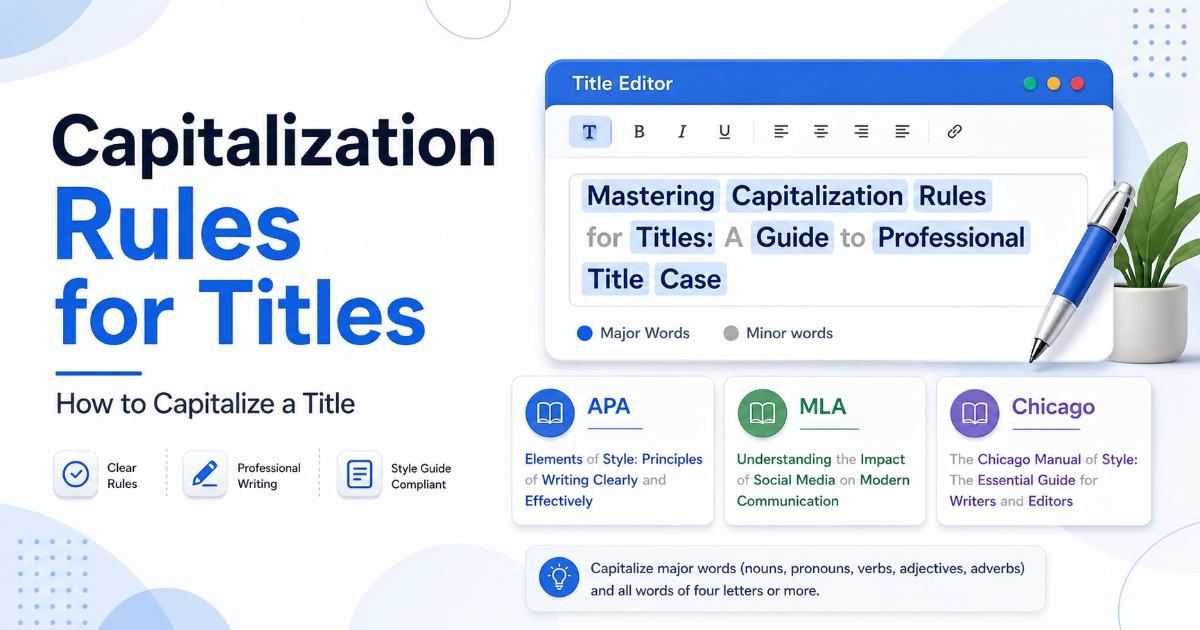
Before examining specific style guide variations, it is essential to understand the core capitalization rules for titles. Title case is built around a simple idea: capitalize the words that carry meaning and lowercase many small function words.
This guide explains how to capitalize a title, when to capitalize words in a title, and how APA, MLA, and Chicago styles differ. For related context, see our guides to title capitalization rules, title case vs sentence case, and headline capitalization.
The Core Principles of Title Case
What is title case?
Title case is a capitalization style where the first word, the last word, and all major words within a title are capitalized, while minor words are typically lowercase. Its purpose is to make titles visually distinct, readable, and professional.
Identifying major vs. minor words
The distinction between major and minor words is central to applying title case correctly.
- Major words: nouns, pronouns, verbs, adjectives, and adverbs.
- Minor words: articles, coordinating conjunctions, and many prepositions.
General Title Case Rules
Always capitalize the first and last word
The first and last word of a title are capitalized regardless of their part of speech. This applies even when the word is normally a minor word.
Example: The Art of Writing Is Important to You
Capitalize nouns, pronouns, verbs, adjectives, and adverbs
These major word categories are consistently capitalized in title case.
- Nouns: The Mountain and the Sea
- Pronouns: She Saw Him
- Verbs: To Be or Not to Be
- Adjectives: A Beautiful and Bright Day
- Adverbs: Moving Quickly and Silently
Lowercase articles, conjunctions, and short prepositions
Articles such as a, an, and the are usually lowercase in the middle of a title. Coordinating conjunctions such as and, but, or, nor, for, so, and yet are also usually lowercase. Many short prepositions, such as in, on, at, to, by, for, and of, are lowercase unless they appear first or last.
Do You Capitalize Prepositions in Titles?
Prepositions are one of the most common sources of confusion. Some style guides lowercase all prepositions unless they are first or last, while others use a length threshold. APA, for example, treats many words of four letters or more differently from shorter words.
- A Walk in the Park
- The Cat and the Fiddle
- From Dawn to Dusk
- The End Of It All
Because style guides differ, a case converter is best used as a starting point. Always review the result against the style guide you need to follow.
Hyphenated Words, Subtitles, and Colons
Handling hyphenated words
Capitalize both parts of a hyphenated compound if each part would be capitalized individually. If the second part is a minor word or modifies the first part, it may remain lowercase depending on the style guide.
- Well-Known Author
- Twenty-First Century
- Mother-in-Law
- Run-of-the-Mill
Capitalizing subtitles and colons
When a title includes a subtitle separated by a colon, the first word after the colon is capitalized. The subtitle then follows normal title case rules.
Example: The Digital Divide: A Study of Online Access
Style-Specific Capitalization Rules for Titles
Academic style guides are especially important here: compare APA title capitalization with MLA title capitalization before formatting paper titles, reference entries, or Works Cited source titles.
Style Guide Comparison
| Style | Common rule | Example |
|---|---|---|
| APA | Title case in text, sentence case for many reference list titles. | The Impact of Social Media on Adolescent Development |
| MLA | Capitalize major words; lowercase articles, conjunctions, and prepositions unless first or last. | A Farewell to Arms |
| Chicago | Traditional title case with detailed rules for compounds and prepositions. | The Old Man and the Sea |
| AP | Often sentence case for headlines; title case for formal titles with its own small-word rules. | New report outlines health policy changes |
Title Capitalization Examples
Book title capitalization and article headings
- The Catcher in the Rye
- Research on the Effects of Climate Change
- Research on the effects of climate change: A global perspective.
- To Kill a Mockingbird
- One Hundred Years of Solitude
Movie, song, and play titles
- Gone With the Wind
- Bohemian Rhapsody: A Night at the Opera
- A Streetcar Named Desire
Website and blog post titles
- Mastering SEO: A Guide to Higher Rankings
- The Future of AI in Content Creation
- How to Write Engaging Headlines for Your Blog
If you are editing a full article or page, the word counter can help review title length, article structure, and reading time before publishing. For a broader casing overview, use the text case formatting guide.
Conclusion
Mastering capitalization rules for titles is a fundamental skill for writers who want clarity and professionalism. The general rules of title case provide a strong foundation, but APA, MLA, Chicago, and AP introduce important differences.
By understanding major and minor words, capitalizing first and last words, and checking style-specific rules for prepositions, conjunctions, and hyphenated terms, you can make your titles consistent, polished, and publication-ready.