
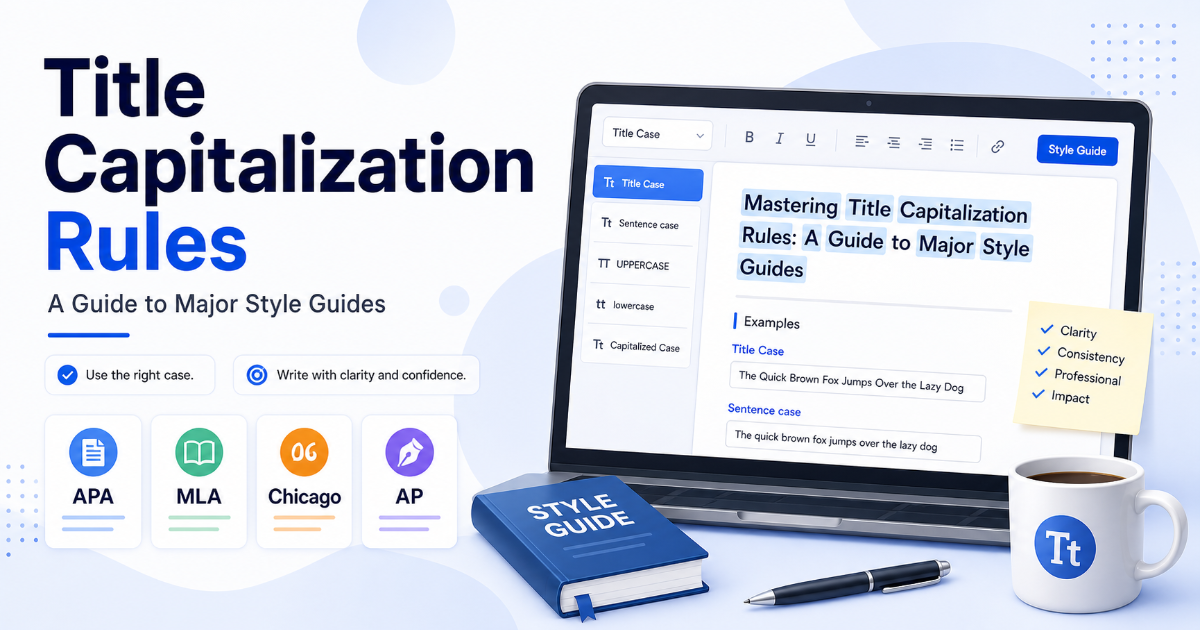
Correct title capitalization is a hallmark of professional writing. It signals attention to detail, keeps headings consistent, and helps readers trust the content in front of them. The tricky part is that title capitalization rules change depending on whether you are following APA, MLA, Chicago, AP, or a house style.
This guide explains title case vs sentence case, when to capitalize words in a title, and how articles, conjunctions, and prepositions behave across the major style guides. For a broader overview of casing patterns, see our text case formatting guide, or use the case converter when you need to convert text case quickly.
Understanding the Core Principles
At its heart, title capitalization means deciding which words in a title should begin with an uppercase letter. That decision starts with the format you are using, then narrows based on the grammatical role and sometimes the length of each word.
For a practical companion with more examples, review our capitalization rules for titles.
Title Case vs Sentence Case
Title Case and Sentence Case
| Format | Rule | Example |
|---|---|---|
| Title Case | Capitalize major words. Lowercase many articles, short prepositions, and coordinating conjunctions unless they appear first or last. | The Art of Writing Clear and Concise Titles |
| Sentence case | Capitalize the first word, the first word after a subtitle break, and proper nouns. | The art of writing clear and concise titles |
Title case is commonly used for book titles, article titles, formal headings, and polished page titles. Sentence case is often used for AP-style headlines, email subject lines, figure captions, table headings, and APA reference list titles. For web and editorial titles, see our guide to headline capitalization.
Articles, Conjunctions, and Prepositions
Minor words cause most title capitalization confusion. In title case, articles such as a, an, and the are usually lowercase unless they begin or end a title or subtitle. Coordinating conjunctions such as and, but, or, nor, for, yet, and so are also usually lowercase in the middle of a title.
Prepositions are where style guides differ most. Some guides lowercase prepositions regardless of length, while others use a word-length threshold. When in doubt, follow the style guide required by your school, publication, brand, or editor.
Quick rule
In title case, always capitalize the first and last words of a title or subtitle, even if those words are articles, conjunctions, or prepositions.
Major Style Guide Rules
APA Title Capitalization
APA style is common in psychology, education, and the social sciences. In the body of a paper, APA uses title case for titles of works. Capitalize major words and words of four letters or more. In reference lists, APA uses sentence case for many work titles; see our full APA title capitalization guide for paper titles, headings, and references.
In-text example: The Impact of Social Media on Adolescent Development
Reference list example: The impact of social media on adolescent development
MLA Title Capitalization
MLA style is widely used in literature, language, and the humanities. Capitalize nouns, pronouns, verbs, adjectives, adverbs, and the first and last words of titles and subtitles. Lowercase articles, coordinating conjunctions, and prepositions unless they appear first or last; our MLA title capitalization guide covers Works Cited examples in more detail.
Example: A Study of the Influence of Romanticism on English Poetry
Chicago Style Title Capitalization
Chicago style is common in publishing, history, and the arts. It capitalizes first and last words, nouns, pronouns, verbs, adjectives, adverbs, and other major words. It lowercases articles, coordinating conjunctions, and prepositions unless they appear first or last.
Example: The History of the World: From Ancient Times to the Present Day
AP Style Title Capitalization
AP style is standard in journalism. AP headlines commonly use sentence case. Formal titles of works, such as books and movies, use title case: capitalize words of four letters or more and lowercase articles, coordinating conjunctions, and prepositions of three letters or fewer unless they are first or last.
Headline example: New study finds link between diet, heart health
Formal title example: The Grapes of Wrath
Title Capitalization Examples
Consider the title the impact of artificial intelligence on modern society. Here is how it changes by context:
- APA in-text: The Impact of Artificial Intelligence on Modern Society
- APA reference list: The impact of artificial intelligence on modern society
- MLA: The Impact of Artificial Intelligence on Modern Society
- Chicago: The Impact of Artificial Intelligence on Modern Society
- AP formal title: The Impact of Artificial Intelligence on Modern Society
These examples show why the same words can look different in a paper, reference list, news headline, or formal title. If you are editing several titles at once, combine a word counter for length checks with a manual style-guide pass before publishing.
Exceptions and Special Cases
- Brand names and acronyms: Preserve established capitalization such as iPhone, eBay, NASA, and API.
- Hyphenated words: Rules vary, but major words in compounds are often capitalized. Chicago gives especially detailed guidance.
- Foreign language titles: Follow the capitalization conventions of the original language rather than forcing English title case.
- Creative style: Marketing or literary choices may break normal rules, but academic and professional contexts should follow a chosen guide consistently.
Best Practices for Professional Titles
- Choose a style guide before editing a title.
- Capitalize the first and last words in title case.
- Keep articles and coordinating conjunctions lowercase in the middle unless your guide says otherwise.
- Check prepositions carefully because style guides differ.
- Review verbs such as is, are, and be; they are major words in title case.
- Proofread proper nouns, acronyms, brand names, and hyphenated compounds manually.
Related Tools for Title Formatting
Title capitalization rules are easier to apply when your editing workflow is organized. These tools help you clean up titles, check length, and prepare content for publication.
Case Converter
Convert text case between title case, sentence case, uppercase, lowercase, and more.
Word Counter
Check title length, character count, reading time, and content metrics while editing.
Text Case Formatting Guide
Learn how title case, sentence case, uppercase, lowercase, and other formats compare.
Mastering Title Capitalization
Consistent title capitalization is more than a grammar detail. It improves readability, conveys authority, and shows that your writing has been edited with care. Once you understand title case vs sentence case and the main differences between APA, MLA, Chicago, and AP, most title decisions become much easier.
For practical work, pick the required style guide, apply it consistently, and review exceptions before publishing. A converter can speed up formatting, but the final polish still comes from knowing the rules.