
Accurate academic and professional writing demands careful attention to detail, and APA Title Capitalization is one of the places where that detail shows immediately. Correctly capitalizing titles, headings, and reference list entries is not just a style preference; it helps your writing look consistent, scholarly, and easier to scan.
APA style mainly uses two capitalization systems: APA style title case and APA sentence case. This guide explains when each one applies, how to capitalize titles in APA, and how to avoid common mistakes. For broader comparisons, see our guides to capitalization rules for titles, title capitalization rules, and title case vs sentence case.
Understanding APA Title Capitalization Rules
The foundation of APA capitalization is knowing whether the element needs title case or sentence case. These styles look similar at a glance, but they follow different rules and appear in different parts of an APA paper.
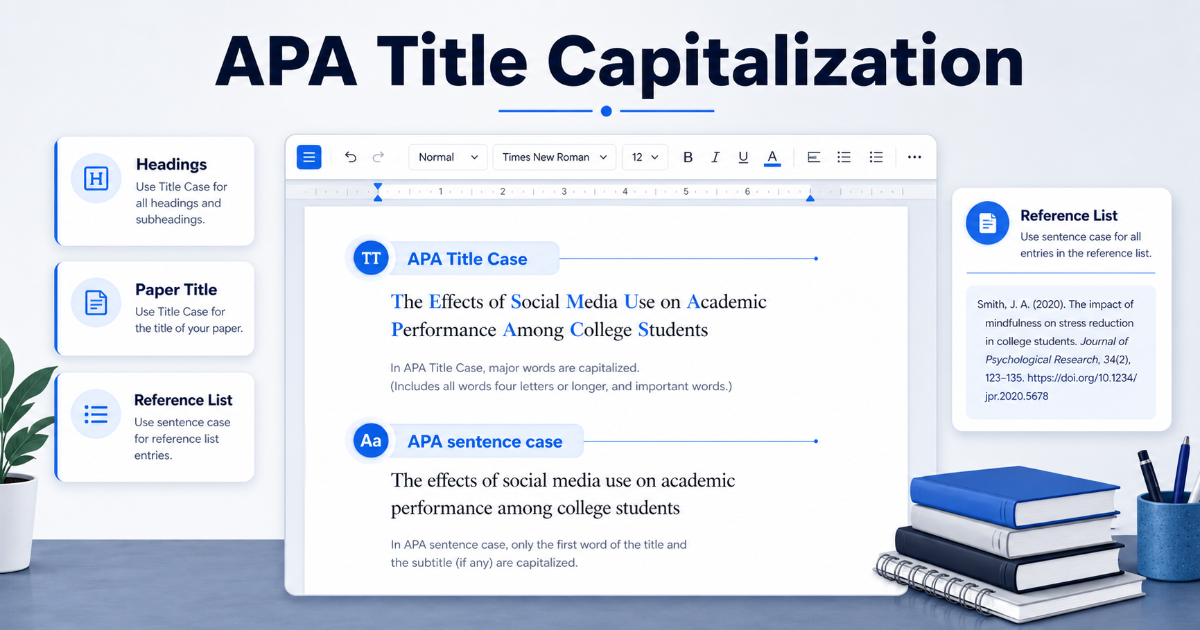
What is APA style title case?
APA style title case capitalizes all major words in a title or heading. Major words include nouns, verbs, adjectives, adverbs, and pronouns. Minor words such as short conjunctions, articles, and short prepositions are usually lowercase unless they appear at the beginning of the title, the beginning of a subtitle, or in a position where APA rules require capitalization.
What is APA sentence case?
APA sentence case is more restrained. Capitalize only the first word of the title, the first word after a colon or em dash, and proper nouns. All other words remain lowercase unless they would normally be capitalized as names, places, organizations, acronyms, or other proper terms.
When to Use APA Title Case
Title case is reserved for prominent elements within your paper and for formal titles mentioned in the text. These items need to stand out visually and align with APA heading and title conventions.
APA paper title capitalization
The main title of a research paper, thesis, dissertation, or class assignment should appear in title case on the title page and at the beginning of the paper.
Example: The Impact of Social Media on Adolescent Mental Health: A Longitudinal Study
APA heading capitalization for Levels 1 and 2
Level 1 and Level 2 headings use title case. Level 1 headings are centered and bold; Level 2 headings are flush left and bold.
- Level 1: Methodology: Participants, Materials, and Procedures
- Level 2: Data Collection and Analysis Techniques
Book and journal titles in text
When you mention a book title or journal title in the body of your paper, use title case and italicize the title.
Example: The findings appeared in Journal of Applied Psychology.
When to Use APA Sentence Case
APA sentence case is most common in the reference list and in lower-level headings. This is a key difference between the way a title may look in your prose and the way it should appear in a reference entry.
APA reference list capitalization
For most reference list entries, the titles of articles, chapters, reports, and webpages use sentence case. Capitalize only the first word of the title, the first word of any subtitle, and proper nouns.
APA Title Case vs. Sentence Case
| Element | APA capitalization | Example |
|---|---|---|
| Paper title | Title case | The Role of Sleep in Memory Formation |
| Level 1 and 2 headings | Title case | Results and Discussion |
| Article title in references | Sentence case | The effects of mindfulness meditation on stress reduction |
| Chapter title in references | Sentence case | Adolescent development and peer influence |
Specific APA Capitalization Rules and Nuances
Hyphenated words in APA titles
Hyphenated compounds depend on the capitalization system. In title case, capitalize both parts when each part functions as a major word, such as Decision-Making. In sentence case, capitalize only the first word unless the second part is a proper noun, such as Self-report or Pre-Columbian.
Short words, prepositions, and conjunctions
In title case, minor words are usually lowercase in the middle of a title. However, capitalize a minor word when it is the first word of the title, the first word after a colon, or required by the specific APA title case rule you are applying.
Proper nouns and acronyms
Proper nouns and acronyms keep their standard capitalization in both systems. Names such as Freudian Theory, NASA, APA, and United States should remain capitalized where appropriate.
If you are quickly testing different casing styles, a case converter can help you convert text case before you manually review APA-specific exceptions.
APA Title Capitalization Examples
Examples of APA title case
- The Impact of Cognitive Behavioral Therapy on Anxiety Disorders: A Meta-Analysis of Recent Studies
- Methodology: Participants, Materials, and Procedures
- Data Collection and Analysis Techniques
- The Social Psychology of Influence
- Psychological Bulletin
Examples of APA sentence case
- The effects of mindfulness meditation on stress reduction: A randomized controlled trial
- Adolescent development and peer influence
- Participants' demographic characteristics
- Cognitive behavioral therapy for anxiety disorders
For related writing decisions, compare this APA-focused guide with our headline capitalization article and the broader text case formatting guide.
Common Mistakes to Avoid
- Over-capitalizing reference entries: Article, chapter, report, and webpage titles usually use sentence case in APA references.
- Under-capitalizing major headings: Level 1 and Level 2 headings should use title case.
- Forgetting subtitles: Capitalize the first word after a colon or em dash in both title case and sentence case.
- Changing acronyms: Keep acronyms and initialisms in their normal capitalization.
- Applying one rule everywhere: APA title capitalization changes based on whether the title appears in text, a heading, or the reference list.
Conclusion
Precise APA Title Capitalization helps academic writing look consistent, credible, and publication-ready. The essential habit is to identify the element first: paper titles and major headings usually need title case, while most reference list titles need sentence case.
By applying APA capitalization rules consistently, checking proper nouns and acronyms, and reviewing subtitles and hyphenated words carefully, you can make your papers and references cleaner, clearer, and aligned with APA style. If you write in the humanities, compare these choices with MLA title capitalization.